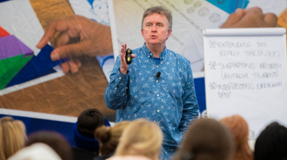
- The different stages of number development - what they are and how to determine at which stage a child is.
- Developmentally appropriate activities that support the development of number sense.
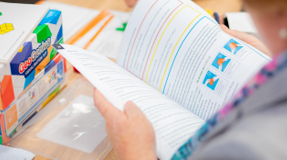
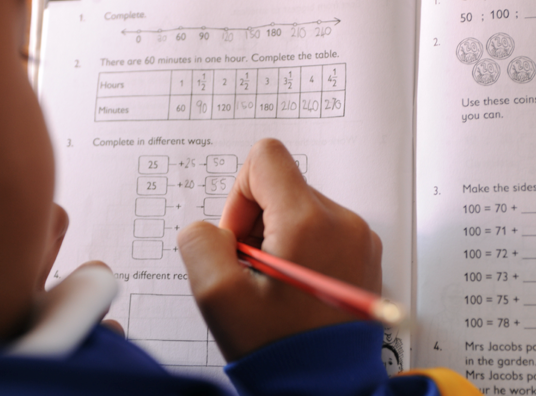
- The relationship between teacher-led classroom activities and independent written activities (including the effective use of the Number Sense Workbook Series).
- The effective integration of different calculation strategies.
- The role of patterning in developing Number Sense in particular and Mathematical Proficiency in general.
- An appropriate sequence (trajectory) of teaching and learning activities to support the development of patterning.
- Different patterns, representations and patterns and their interrelationship.
- Patterns in the Number Sense Workbooks.
- The importance of making the right start when teaching fractions and the dangers of not starting well.
- An appropriate sequence (trajectory) of teaching and learning activities to support the development of the fraction concept.
- Calculating with fractions.
- Fractions in the Number Sense Workbooks.
- Saturday 18 August 2012, Pietermaritzburg: Teaching Fractions – download registration form from alongside.
Latest News
Developing Number Sense Workshop Series 2012
Number Sense
The anticipated workshop dates and venues:
Participants at previous workshops have said:
"The workshop was absolutely great. As an experienced teacher of in the foundation phase I felt overwhelmed to watch a senior or secondary person like yourself so comfortably come down to the level we teach at in the foundation phase.
I was talking to educators at school about the workshop and was wondering when would you be doing another workshop in KZN. Our intermediate phase teachers would love to attend your presentation. Thank you again for enlightening us on a few things we sometimes overlook as time passes by."
"Wonderful! Just the right stuff to get us motivated to change. We're all talking about the workshop in the staffroom."
"Thanks you for a wonderful presentation on Saturday. So much of what you said validated my own opinions and thoughts on how we teach Maths and how we should teach Maths. I came away feeling as if I haven’t been misplaced in my views and methods and perhaps need to be more persuasive in convincing others to make some changes!"
"Thank you for the very informative and intense workshop that was held at Eden College on Saturday.
My colleagues are so impressed and cannot stop talking about the value of the information they gathered and the continued need for educators to be workshopped on such an important learning area – Mathematics."
"We chatted briefly at the workshop where I told you how much I enjoyed all that I had learnt. I have worked in the corporate world before studying my PGCE and deciding to become a teacher. As much as I love the classroom I always felt ill-equipped when dealing with Mathematics due to many gaps experienced during my Primary School years.
Not only did the workshop build my confidence that I was actually doing a lot of things right in the classroom, It also helped me fill many gaps in my own development, something that my class is already benefitting from.
I believe passionately that as educators we strive to equip our students for life, not merely to pass Matric. I want to do all I can to shape and mould a generation that is relevant and forward-thinking. It was a delight to discover that I could achieve that goal not only through creative writing and LO but through Maths as well.
I'm well aware that you're going to be receiving feedback with intellectual commentary and mathematical jargon, but I'm not at that stage yet and so instead, I thought I would express my heartfelt thanks.
In the life of a young teacher at the beginning of her career, you have made an enormous impact in helping Numbers make Sense.
Good Luck with all future endeavours!"
"Thank you so much for your inspiring workshop on Saturday. I was reminded of so many things I take for granted and then forget to do. I found your workshop practical and valuable. I think the children at our school are going to benefit greatly."
We work in 3 key areas in mathematics:
Training
We support and train teachers and college lecturers to teach Mathematics and Mathematical Literacy.
Materials Development
We develop teaching support materials and curriculum to meet the requirements of our clients and their setting.
Research
We research for our clients on interventions and/or the state of teaching and learning in contexts and recommend improvements.